Showing posts with label Hrishikesh Mukherjee. Show all posts

Thursday, September 11, 2008

'SATYAKAM' - Dharmendra's Best Performance?

I’ve wanted to watch ‘Satyakam’ for ages… about 2 years now actually, ever since I first read a review that described Dharmendra’s performance in it as his career best. It wasn’t easy, but I finally got my hands on it. My next post was supposed to be about something light-hearted and frivolous…‘Satyakam’ is anything but. Don’t get me wrong, it’s not exactly a depressing, dark film – but it definitely made me pause and reflect, which I think was what Hrishikesh Mukherjee and his team intended.


Speaking of the late Hrishikesh Mukherjee, I am a huge fan of his work – he’s my favourite Hindi film director and I’ve loved all the films he directed (that I’ve seen so far). But ‘Satyakam’ was totally different from the others I’ve seen, which is interesting as it’s also the earliest one (1969) that I’ve seen. It’s not fun and light-hearted (like ‘Chupke Chupke’ or ‘Gol Maal’), and it doesn’t quite have the sweetness of a ‘Guddi’ or ‘Bawarchi’ or the heart-tugging (but nicely done) melodrama of a ‘Mili’ or ‘Abhimaan’. ‘Satyakam’ is measured and restrained. It unwinds slowly (perhaps a little too slowly at the beginning, actually) and its tone is reflective. I love the fact that it raises more questions that it answers, leaving its audience to ponder on the issues for itself.


Where is the balance (if there is one) between being ‘yourself’ and adapting to the harsh realities of your environment? How much of your true self is dictated by your genes and the circumstances of your birth, and how much is dictated by life experience and the pressures of everyday living? Are values important enough to live or die for? Does dogmatism always either devour itself or collapse into hypocrisy? Can one man really take on the system? Must there be a sacrifice of values for the sake of ‘greater good’ (however defined)? Where is the balance between personal honour and emotional truth? Is there even such a thing as truth, or is it really all about shades of grey and personal judgment?


Speaking of judgment, is it really possible to ‘temper justice with mercy’? What dictates the true value of a life? Where is the line between the protection and preservation of self and family interests on the one hand and the service of higher interests on the other? These are just some of the questions that ‘Satyakam’ raises. It doesn’t answer them all, but in raising them, it tells a compelling story of one man’s devotion to truth, the people he meets along his path, and how ‘successful’ he is at being the man he aspires to be. There is also an interesting subtext that I feel was a bit under-developed (or maybe I was just rather inadequate at unpacking it) – the relationship between Satyakam’s story and the story of a young and newly independent India, finding its feet, making its choices, navigating the constant socio-moral seesaw between concession and right, and arriving at its own destiny.


Satyapriya (played by Dharmendra) comes from a long line of honest, upright, truth-tellers. He has been raised in the long-held family traditions of honour, truth and respectability by his beloved and noble grandfather (played by the brilliant Ashok Kumar). While at college, he meets and becomes firm friends with Naren (played by Sanjeev Kumar in one of his first film roles).


After college, the friends separate and Satyapriya (‘Sat’) takes his first job as a project engineer. He quickly comes face-to-face with corrupt, self-serving, dishonest men. From Day 1, he firmly and boldly takes a stand against every practice that goes against his values, and of course, there are consequences. While dealing with this, he also meets the beautiful but sad Ranjana, a young woman cast out of honourable society due to the circumstances of her birth and destined (it seems) to become the plaything of wealthy men. Even her own guardian has no quibble with subjecting her to this future – as far as he’s concerned, she can hope for nothing better with her history, and life in ‘service’ to a rich, lecherous will at least fetch a handsome income.


When Satya becomes familiar with her circumstances, he wants to help but is torn between the demands of heritage and reputation, and the need to protect a helpless woman who cares for him (and who he comes to care for). In many ways, this proves to be a watershed moment in his life. What does Sat choose to do? How does his decision affect his relationships and his future? How does he come to terms with the fact that he will always walk alone? How does his fierce, black-or-white brand of personal integrity hold up against the challenges of his future? Does he find peace and personal fulfillment in the life he has chosen? Well, you'll have to watch this film and find out for yourself.


Although I said earlier that ‘Satyakam’ isn’t like any of the other Mukherjee films I’ve seen, it does have some of his hallmarks. As always, he is masterful at setting up moments and scenes that are so poignant and real that they stay with you long after the film is over. The film has the grace of his other films (but is less formulaic and more multi-dimensional than the others I’ve seen). I always love how Hrishikesh Mukherjee could capture something special and intimate in the most seemingly mundane, simple things. Another thing I love about ‘Satyakam’ is the fact that, with its subject matter, it could very easily have degenerated into an over-simplified preach-fest, with Satya hitting us over the head with melodramatic railings on the value of honour; but instead it’s restrained, dignified, and rich with subtext. I love that.


The cast of ‘Satyakam’ features some of Mukherjee’s ‘favourites’: David, Asrani, Ashok Kumar. Then of course, there’s the core cast: Dharam, Sharmila and Sanjeev. The choice of Dharmendra for this role, to my mind, must have gone across the grain – the role of Satya is no simplistic, hackneyed ‘handsome hero’ part – it requires real acting to capture the complex situation and emotions of this character – but Dharam does a bang-up job of it. He really is ‘Sat’ – he reflects the inner resolve and grapplings of his character beautifully and with great restraint, while also balancing this out with Sat’s charm, humanity, simplicity and honesty. It’s a lovely performance.


The rest of the cast is excellent as well – Ashok Kumar is fantastic as usual in his small (but pivotal) role, especially in the film’s final scenes, a young Sanjeev Kumar is simply brilliant as the sweet Naren – he perfectly embodies the ‘everyman’ that his character is – I loved how wonderfully he brought to life the love, and most importantly, the respect, that has for Sat.

Sharmila Tagore is also excellent as Ranjana – although I felt that her character wasn’t given sufficient dimension until much later in the film, she uses her acting chops effectively to keep the character from becoming a boring caricature, and when she does gets some ‘meat’ later in the film, she goes for it and really makes her character memorable.


Memorable... that’s the word I would use to describe ‘Satyakam’. When I had finished watching it, I felt like I had been put through the wringer. I felt like I had felt what each of the main characters had felt… I was saddened, but also uplifted. And most of all, watching this film was more than just a pleasant way to spend two evenings. That doesn’t happen very often.

And finally, you may be wondering, do I agree with the pundits who consider this to be my dear Dharam’s best performance? Well, it’s certainly the best I’ve seen so far. It doesn’t have any of the stylish, ultra-cool, Dharam-trademarks that I’ve liked so much in other films of his I’ve seen, but what it does have is deeper and more powerful, and makes me respect him more than I ever have (you gotta excuse a fangirl her schmaltz!)


Up next… a Director’s Round-up (been ages since I did one) on the undisputed king of ‘traditional family values’: Sooraj Barjatya.

Sunday, April 22, 2007

'GUDDI' (1971)

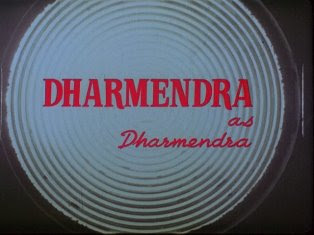
I have raved about Hrishikesh Mukherjee’s directing and Jaya Bhaduri’s acting more than once on this blog… so you can imagine my delight when I recently came across another film starring Jaya and directed by Hrishida (my fifth, after ‘Abhimaan’, ‘Bawarchi’, ‘Mili’ and ‘Chupke Chupke’). The icing on the cake is that ‘Guddi’ also stars my hero, Dharam ji, playing himself. It was an absolutely delightful find, especially in view of my recent discovery of Jaya’s remarks on Dharmendra on ‘Koffee with Karan’ (thanks again for letting me know, Sanket!)


‘Guddi’ is the story of Kusum (her pet name is ‘Guddi’, which means ‘doll’ – a very clever symbol in this film), a young schoolgirl who is in love with the movies, and especially with her favourite movie star, Dharmendra. She is so in love with him that she doesn’t want to marry a sweet, sincere young man who’s in love with her. However, through a series of visits to Hindi movie sets, she comes to discover that her ideas of glamour and perfection in the movie industry and its stars are nothing but a smokescreen, and that beneath the glowing surface, there are blemishes: inequities, crushing and monotonous hard work, disenchantment, and even callousness. She realises that the love her suitor feels for her (and which she, unbeknownst to her, returns) is real; while her love for Dharmendra is a mirage… and of course it all ends beautifully (I love the final scene so much, it’s so charming).


Gulzar’s script is a beautiful tapestry of metaphors, themes and esoteria – I love the way he intertwines expositions of ideas as varied as the role of the press in the movie industry, the team effort involved in film-making, and the awkwardness that lies in the gap between girlhood and womanhood. It’s all expressed through beautiful music (the stand-out tune is ‘Bole Re Papihara’) and lovingly sketched scenes with just the right amount of sweetness (I love the use of the ‘statue’ game), fantasy (I must admit I was totally fooled by one of the two fantasy scenes), comedy (Asrani’s scene with his mother is hilarious), and social commentary (as found in Dharam’s scene at the old studio – the commentary is totally inoffensive and sincere, and never goes over the top – which I guess is one of the biggest achievements of this film).


I love the ‘mirroring’ effect Mukherjee creates between what’s ‘real’ and what’s not in this film. The lines appear unclear sometimes, but then you realise that what’s being reflected is the magic of the movies as well as the ‘realness’ of the people who work within the movie industry. There is an appealing heartfelt, self-effacing tone to the entire film, especially the ‘movie-making’ part – I am not sure anyone but Mukherjee could have made it work so well - I think with most other film-makers it would have come off as very patronising and preachy. It’s sheer genius – it all appears really simple, but there’s an appealing ‘meatiness’, a hidden complexity beneath the surface.

And Jaya Bhaduri’s performance as Guddi is absolutely marvellous – she captures the conflict within this girl on the cusp of womanhood brilliantly. The transition of her character is subtle and realistic, and it’s expressed through slight changes in her manner, appearance (props to the costumiers and make-up people on this film) and demeanour – absolutely beautiful. I love her acting. Jaya is supported by Samit, Sumita Sanyal, Utpal Dutt, and G. Asrani (one of Hrishida’s faves, here in a memorable little role as a deluded young man consumed with dreams of starring opposite Sadhana or Sharmila).

During the film-set scenes, there’s also a range of stars making special appearances, (for some reason I found those sequences quite moving). Among others, there’s Ashok Kumar, Vinod Khanna (rocking some hot long sideburns – couldn’t get a good pic unfortunately), Rajesh Khanna and even Jaya’s future husband:

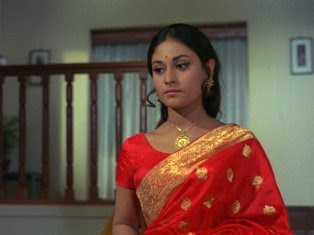
Now for a few screencaps… Jaya looks absolutely stunning in this film (those eyes!), and her evolution is great to watch – I love her first sari scene, her walk is ever so slightly and unselfconsciously awkward – I just think she is such a brilliant actress.

I love that her character never loses her ‘girlishness’, her sense of fun and liveliness – one thing you find sometimes in Hindi films is that the girl suddenly becomes sombre, boring, lifeless and even repressed when she transitions into womanhood. This doesn’t happen with Guddi – she matures, yes, but she doesn’t lose her gutsiness, vivaciousness, warmth and spirit. I love that.

I love the way she laughs – this scene reminded me so strongly of her laughter during ‘Shava Shava’ in ‘Kabhi Khushi Kabhie Gham’.
I also think she makes such a sweet couple with her co-star, and I love their playful, charming chemistry together:

And of course, there’s the obligatory funny subtitle:

This review wouldn’t be complete if I didn’t mention my dear Dharam’s role – playing yourself must be so hard as an actor (the divide between sheer hubris and crushing awkwardness must be difficult to straddle), but he does it with such grace, (apparent) humility and… cuteness. Through his efforts, Guddi loses her girlish crush on him in the course of this story, but I’m afraid this movie has had the opposite effect on me. It’s only made me love him more… so I must now crave your ‘forgivance’ – permit me to indulge my Dharam-love just a little bit…


Guddi’s Dharmendra scrapbook – I love how she’s crossed out his co-star’s face – such a typical fangirly thing…

This scene was fabulously done – it looked just like you’d expect Guddi to imagine it:

Sach, Dharamji?! Bahut bahut shukriya… that means so much to me!

I simply have to find a place for this picture on this blog…

April has been pretty quiet on this blog – not because my Bollyworld has been quiet, but because blogging time has been in short supply – I’m hoping to liven the party up a bit in May though. Up next… a review of the awesome ‘Awāra’, my first Raj Kapoor film – or I should say my first Raj Kapoor starrer, because I have seen a film he directed ('Satyam Shivam Sundaram'). 'Awaara' was very kindly recommended by Rajnish ji, in a comment on my ‘Mother India’ liveblog. On the contemporary tip, I’m also working on a lil’ something about Bollywood’s ‘bunny boilers’. Should be fun.

Monday, February 19, 2007

'CHUPKE CHUPKE'

I had a nice, quiet, peaceful birthday. I had a friend over, shared a cake with my aunt and cousins, took some photos, and visited another friend who recently gave birth to the most beautiful little twins you ever saw. I also saw ‘The Pursuit of Happyness’ with my friend, and I loved it. Will Smith’s performance is great, and his son (also playing his son in the film) is just so cute you want to hug him. It’s a really good film with a lot of inspirational value, and I really enjoyed it (even if it made me cry a little at the end).

I did manage to inject some Bollywood into my birthday. At Maja’s brilliant suggestion, I started the day with the 'Salaam-e-Ishq' soundtrack, and I really enjoyed that. I also watched ‘Chupke Chupke’, a DVD I’ve had for a while but have been too busy to get round to watching (until yesterday).

‘Chupke Chupke’ is yet another charming Hrishikesh Mukherjee film, the fourth I’ve seen so far. It stars some of Mukherjee’s ‘usual suspects’: Jaya Bhaduri, Asrani, Amitabh Bachchan, and some other actors whose names I don’t know but whom I recall from the other Mukherjee movies I’ve seen. It also stars my darling Dharmendra and the adorable Sharmila Tagore. I loved the movie, it was funny and sweet and just so much fun to watch. It’s a comedy, with Dharmendra’s character (with a little help from his friends) trying to put one over his wife’s brother-in-law.

I’m not going to say too much else about it, other than that it’s well worth a watch and everyone in the ensemble cast is really good in it – especially Amit-ji, who steals all the scenes he’s in (although everyone else does a great job too). A few more (illustrated) statements about this film:

I’ve decided I quite like Dr. Bachchan’s son looking and acting all geeky:


Amitabh Bachchan in 'Chupke Chupke' (1975)


Amitabh Bachchan in 'Kasme Vaade' (1978)

Sharmila is too cute in this film:


Especially in yellow:


Dharam is dashing as ever:


And here’s an interesting subtitle to make you wonder (if you haven’t seen the movie):